Connect with Us

Address

Connect with Us

Address

Latest Posts

Building a Resilient Mental Health Ecosystem: Strategy and Opportunity

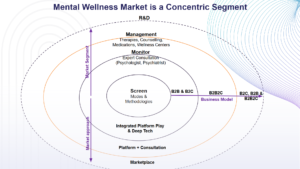
Yes! Over 150 million people in India suffer from disorders related to mental fitness, reflecting a substantial public health challenge. According to the National Mental Health Survey by NIMHANS, about 10.6% of adults in India suffer from mental disorders, and the lifetime prevalence reaches 13.7%—approximately 1 in 7 people require mental health interventions today. The biggest hurdle remains the stigma and taboo surrounding mental illness, which restricts open conversations and timely care. While Gen Z and younger generations are more open to addressing mental health, older generations still face deep-seated stigma and misunderstanding. The scale is massive, and the barriers are strong, making existing programs and systems insufficient to meet the need. The mental awareness market segment in India functions like a concentric ecosystem where various layers coexist and support each other. This interdependency is critical to building an end-to-end platform that advances research and development in precision psychiatry and neurodegenerative remedies. Like other emerging industries such as fintech and agritech, mental wellness is rapidly evolving, marked by technology fragmentation yet immense opportunity. Technology-driven advances in deep tech, AI, and democratized digital access, especially via voice and facial recognition, are transforming screening and monitoring paradigms. Wellness fundamentally depends on deciphering the complex, ever-changing state of mind. In today’s Volatility, Uncertainty, Complexity, and Ambiguity (VUCA) world, an individual’s mental state is continuously exposed to stressors leading to fluctuating wellness. Resilience levels determine severity outcomes, and these mental patterns correlate closely with personality traits that may manifest as erratic behaviors or, in some unfortunate cases, result in severe adverse outcomes without awareness. Two major market drivers are emerging within wellness: Preventive care and management. Prevention in mental health is paramount in a VUCA environment—early screening, self-help modules, and guided consultations are becoming widespread. Over the past decade and especially accelerated by the COVID-19 pandemic, preventive adoption has strengthened considerably. Awareness increased through government programs like the National Tele Mental Health Programme (Tele MANAS), which as of 2025, set up 53 cells across 36 States and UTs, answering over 2 million calls in 20 local languages, reflects a digital shift enhancing accessibility. Key segments include: Screening and Diagnosis: This is the critical entry point largely driven by self-reported and professionally guided questionnaires, followed by clinical validation. Innovations such as voice and facial recognition screening tools, powered by AI and edge computing, are pioneering more efficient and accessible diagnostic routes. Although clinical efficacy validation is ongoing, integrated tech stacks incorporating these tools provide promising avenues to overcome accessibility barriers. Monitoring: WHO guidelines recommend psychiatrists and psychologists for monitoring, but India faces a severe shortage with only 0.75 psychiatrists per 100,000 people (WHO recommends 3). This shortage, coupled with stigma, creates a dire gap in care—especially for progressive cases requiring active management. Digital ecosystems and on-demand consultations are evolving as critical solutions. Data-driven, platform-integrated models can improve prioritization, mobilization, and effectiveness in patient care. Management: The largest sub-segment, driven by rising stress and anxiety among working professionals, includes traditional wellness practices such as yoga and philosophies inspired by guru’s, alongside app-driven wellness programs featured in employee welfare. Given the highly individualized nature of mental health management, customer satisfaction and retention present unique challenges, with acquisition costs and ROI being significant business concerns. This segment is where science meets art, with an increasing role for technology-human hybrid models. Central to these segments is data and computational advances capitalizing on research & development across the wellness ecosystem. This includes advisory roles, governance frameworks, compliance, and validation led by academic and healthcare institutions, government bodies, and special purpose vehicles. With mental health contributing to significant disability-adjusted life years (DALYs) and high economic loss (estimated USD 1 trillion in India from 2012-2030), investing in these ecosystem roles is critical to sustainable impact. As we confront a global mental health crisis impacting over one billion people worldwide, the urgency to rethink and rebuild mental wellness ecosystems on a strategic level has never been greater. Mental health disorders such as anxiety and depression are leading causes of disability and substantial economic loss, costing the global economy an estimated $1 trillion annually. Despite increased awareness and some progress, stigma, underfunding, and workforce shortages continue to restrict access to quality care. The future demands bold, cross-sector collaboration and innovation—leveraging advances in digital health, artificial intelligence, and data-driven precision psychiatry—to democratize mental wellness globally. Mental health care must be recognized not as a privilege but as a fundamental human right, integral to social and economic well-being. The strategic challenge lies in transforming fragmented systems into holistic, accessible, and sustainable ecosystems that prioritize prevention, timely diagnosis, effective monitoring, and personalized management. Key strategic imperatives for the future include: Scaling access to care globally through telehealth, AI-driven diagnostics, and community-based interventions. Combating stigma by embedding mental health literacy in education, workplaces, and public campaigns. Expanding and upskilling the mental health workforce to meet growing demand and improve quality of care. Integrating mental health into primary health systems for early detection and holistic wellness. Leveraging data and technology for precision screening, real-time monitoring, and personalized treatment. Promoting multi-sector collaboration among governments, private sector, academia, and civil society. Prioritizing prevention and resilience-building strategies to reduce the overall mental health burden. Ensuring equitable funding that reflects mental health’s critical role in overall health and productivity.
Read More »

Voice Biomarkers SOP Guide: Screen, Monitor, Report for Mental Health Screening

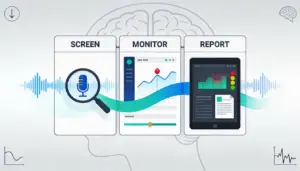
Non-verbal voice biomarkers analyze acoustic patterns like tone, pitch, rhythm, and micro-pauses to detect early signs of depression, anxiety, PTSD, or cognitive decline—often before symptoms appear. In this early adoption phase, a structured Standard Operating Procedure (SOP):Screen, Monitor, Report provides the essential framework for mental wellbeing programs, ensuring seamless integration into workplaces, clinics, and research. Why Voice Biomarker SOP Drives Mental Health Change Management Emerging voice biomarker technology requires clear protocols to build trust and overcome adoption barriers. The Screen-Monitor-Report SOP delivers scalable, privacy-first, non-invasive architecture, converting voice data into actionable mental health screening insights for employers, clinicians, and teams. This standardized approach minimizes errors, optimizes resources, and scales employee mental wellness without stigma. Screen SOP: Non-Invasive Voice Biomarker Detection Purpose: Launch early mental health screening using AI-powered analysis of short voice clips from any device. How Voice Biomarker Screening Works: Capture 25-30 second voice prompts during routine calls, apps, or recruitment processes. AI extracts biomarkers signaling stress, bipolar disorder, dementia, fatigue, or Alzheimer’s precursors. Generate real-time risk flags without overwhelming mental health professionals. Implementation Tip: Schedule weekly voice biomarker wellness check-ins to establish population baselines, prioritizing high-risk individuals for intervention. Monitor SOP: Continuous Mental Fitness Tracking Purpose: Centralize voice biomarker data for trend analysis, personalized reports, and proactive anomaly detection. Voice Monitoring Process: Create unit-level dashboards for longitudinal vocal pattern analysis. Configure customizable triggers (e.g., pitch variation >15% week-over-week). Produce personalized mental fitness reports correlating vocal shifts with anxiety or cognitive changes. Pro Tip: Deploy anomaly alerts for early intervention—such as peer support recommendations—reducing escalation times by 50%. Report SOP: Data-Driven Mental Health Decision Making Purpose: Transform voice biomarker insights into actionable heatmaps, policies, and research advancements. Reporting Workflow: Generate multi-dimensional analytics: organization-wide heatmaps, individual progress tracking. Support evidence-based policy development for workplace mental health programs. Enable R&D through anonymized datasets for voice biomarker model refinement. Leadership Tip: Deliver quarterly executive summaries demonstrating ROI from voice biomarker-driven wellbeing initiatives. Voice Biomarker SOP vs Traditional Methods: Key Differentiators The Screen-Monitor-Report SOP outperforms legacy mental health screening approaches: Voice Biomarker SOP Implementation Roadmap Team Education: Conduct 30-minute voice biomarker SOP training sessions. Pilot Program: Test Screen phase with one department before full rollout. Success Metrics: Track early interventions, engagement rates, and accuracy improvements. Continuous Optimization: Refine detection thresholds using organizational data. About Manodayam: Precision Psychiatry Innovation Manodayam pioneers AI-driven mental wellness through its integrated stack—Manovak for voice biomarker screening, Manovak API for seamless app integrations, and Manolytics for advanced analytics dashboards. Focused on precision psychiatry and employee wellbeing, Manodayam empowers organizations, researchers, and clinicians with privacy-first, scalable tools to screen, monitor, and report mental health proactively. Join our ecosystem partnerships to co-build the future of accessible mental health solutions

Read More »

Voice Biomarkers: The Future of Precision Psychiatry and Mental Wellness

Voice biomarkers are revolutionizing mental health by using AI to analyze acoustic patterns like pitch, rhythm, and micro-vibrations from speech, enabling early detection of conditions such as depression, anxiety, and Parkinson’s disease. What Are Voice Biomarkers? Voice biomarkers extract thousands of non-verbal acoustic features from everyday speech, such as prosody, breath patterns, and spectral energy, without relying on what is said. Recent studies show these features detect depression with 71% sensitivity and 73% specificity using just 35-second clips, outperforming traditional self-reports in scalability. For neurodegenerative disorders, biomarkers like vowel imprecision correlate with Parkinson’s progression, offering non-invasive screening years before symptoms worsen. Manodayam’s Application Stack for Precision Psychiatry Manodayam leads with an integrated stack—Manovak, Manovak API, and Manolytics—tailored for research, development, and mental wellness programs. Manovak delivers AI-powered voice screening for emotional states and cognitive decline, processing voice into spectrograms for real-time symptom prediction. The Manovak API enables seamless embedding into apps and telehealth platforms, supporting continuous monitoring with high accuracy in psychiatric cohorts. Manolytics provides advanced analytics dashboards, aggregating longitudinal data to track risk ratios—improving from 1.53 for single samples to 2.00 over weeks—for precision psychiatry interventions. This stack accelerates R&D by supplying diverse voice datasets, fostering AI models for depression, PTSD, and Alzheimer’s early detection. Empowering Employee Wellbeing with Manodayam Tools Organizations gain a wellbeing-center focus through Manodayam’s ecosystem, where Manovak API integrates into HR platforms for anonymous voice check-ins during calls or apps. This flags burnout or anxiety early, reducing stigma with 24/7 confidential support, as AI chatbots like those powered by similar tech cut symptoms by 30%. Manolytics generates reports for leaders, highlighting trends across teams without individual privacy breaches, enabling proactive wellness programs. For industries like BPO, education, and public sector, this keeps employee mental health central, tying voice biomarkers to retention and productivity. Ecosystem Partnerships and the Manodayam Play Manodayam’s partnership program builds a collaborative ecosystem, inviting insurers, telehealth providers, and corporates to co-develop via the API and shared datasets. Partners access Manovak for custom screening in eldercare or uniform forces, while Manolytics fuels joint R&D for scalable mental wellness. This open play accelerates adoption, as seen in global validations where voice biomarkers scale clinical trials efficiently. By 2026, expect widespread integration in precision psychiatry, with Manodayam at the forefront for mental health innovation. Voice biomarkers via Manodayam’s stack promise accessible, data-driven mental wellness—join the partnership to shape the future.

Read More »

Schedule Demo

Thank you for your message. Our team will respond within 24 hours.

Partner With Us

Thank you for your message. Our team will respond within 24 hours.

Reach Us To Know More

Thank you for your message. Our team will respond within 24 hours.

Let's connect!

Thank you for your message. Our team will respond within 24 hours.

Let us pause to ask ourselves:

  • How often do we prioritize the mind that shapes our every thought, decision, and dream?
  • What silence or stigma have we allowed to shadow those silently struggling around us?
  • Are we truly creating spaces where mental wellness is not a privilege but a shared right—accessible, respected, and nurtured?
  • We, as individuals, institutions, enterprises, and government, commit to this profound truth: Mental wellness is not just a personal journey—it is a collective responsibility.

  • See mental health not as an afterthought but as fundamental to human dignity and societal progress.
  • Break the chains of silence and stigma, listening without judgment and supporting without limits.
  • Educate ourselves and others relentlessly, for ignorance is the soil where suffering grows.
  • Build environments that hold mental wellness as a sacred priority, where every voice is valued and every struggle met with care.
  • Uphold rigorously the laws and policies that protect mental health as a constitutional right.
  • Invest not only resources but our time, empathy, and innovation to weave mental wellness into the fabric of our nation.
  • Hold ourselves accountable, individually and collectively, because the transformation we seek demands courage, consistency, and compassion.
  • On this day, we do more than pledge words—we commit to action, reflection, and relentless hope.
  • For when mental wellness thrives, every life flourishes.
  • Signed on Mental Wellness Day, 10th October 2025.

Advisors

Dr. Amarjyoti Gupta

Advisor

Dr. Kiran Jhakar

Advisor

Advisors

Dr. Amarjyoti Gupta

Advisor

Dr. Kiran Jhakar

Advisor

Sh Shailendra Tiwari

Advisor, Funding, Corporate Planning and Strategy

State-of-Mind Dimension
Voice Biomarkers
Individual Tracking
Organizational Trends
Emotional Load
Vocal energy, pitch variability, speech rate
Daily stress trajectories
Campus/unit crisis peaks
Cognitive Fatigue
Learning capacity decline
Operational readiness drops
Social Withdrawal
Volume modulation, prosody patterns
Isolation risk scoring
Team cohesion breakdown
Neurodegenerative Risk
Tremor frequency, vowel formants
Early-onset detection
Force-wide prevalence
Resilience Capacity
Recovery speed post-stress, baseline stability
Personal growth tracking
Institutional wellness ROI
Dimension
Traditional Approach
Manodayam Platform
Operational Impact
Detection Speed
Days to weeks (post-incident reporting)
Real-time (during routine communications)
Proactive vs. reactive intervention
Coverage
24/7 continuous monitoring
Never miss warning signs
Operational Disruption
High (removes personnel for evaluation)
Minimal (passive background analysis)
Maintains operational effectiveness
Data Richness
Subjective questionnaire responses
Multi-parameter voice biomarker analysis
Objective, clinically validated insights
Scalability
Limited by counselor availability
Institution-wide deployment
Support entire commands
Unit Command Intelligence
Aggregated anecdotal reports
Precision psychological readiness dashboards
Data-driven leadership decisions
Observable Signal
Traditional Questionnaire
Voice Biomarker Analysis
Clinical Relevance
Vocal Energy
Not measured
Continuous tracking
Depression indicator
Pause Frequency
Speech rate analysis
Cognitive load assessment
Pitch Variability
Not measured
Prosody tracking
Emotional state marker
Articulation Precision
Not measured
Formant analysis
Fatigue & neurodegenerative risk
Tremor Frequency
Not measured
Acoustic micro-tremor
Anxiety & PTSD marker
Integration Point
Current System
Functionality
Strategic Benefit
Update Medical Records
Existing System
Automated health record updates with voice biomarker analysis results
Holistic health tracking, integrated clinical decision-making
Training Systems
Embedded wellness checks within training cycles
Routine mental fitness assessment without disrupting training schedules
Communication Networks
Subjective questionnaire responses
Multi-parameter voice biomarker analysis
Objective, clinically validated insights
Scalability
Existing radio, mobile, and operational communications
Passive voice monitoring during routine communications
Continuous screening without dedicated assessment sessions
Command Dashboards
Unit and command-level management systems
Psychological readiness analytics and resource recommendations
Data-driven command decisions on personnel and resource allocation
Why Voice Outperforms Other Methods
Traditional Screening
ManoVāk Voice Analysis
Signal Richness
Questionnaires (conscious bias)
Biomarkers (subconscious truth)
Detection Speed
Real-time (35 seconds)
Scalability
Counselor-limited
Unlimited (any device)
Invasiveness
Subjective, stigmatizing
Passive, conversational
Accuracy
48 - 55% (PHQ-9)
70 - 87% (longitudinal)
SOP Component
Traditional Screening
Manodayam Advantage
Screening Scale
Limited by counsellor availability; monthly/quarterly only
Institution-wide screening; continuous monitoring
Data Collection
Automated voice assessments, unified digital repository
Risk Identification
Delayed; based on student self-report and observation
Real-time alerts powered by voice biomarker analysis
Intervention Speed
Days to weeks for follow-up
Immediate notifications to designated counselors
Regulatory Reporting
Manual compilation; error-prone; time-intensive
Automated compliance reports; audit-ready documentation
Outcome Tracking
Limited follow-up; no systematic evaluation
Longitudinal tracking; intervention effectiveness metrics
State-of-Mind Dimension
Voice Biomarkers
Individual Tracking
Organizational Trends
Emotional Load
Vocal energy, pitch variability, speech rate
Daily stress trajectories
Campus/unit crisis peaks
Cognitive Fatigue
Learning capacity decline
Operational readiness drops
Social Withdrawal
Volume modulation, prosody patterns
Isolation risk scoring
Team cohesion breakdown
Neurodegenerative Risk
Tremor frequency, vowel formants
Early-onset detection
Force-wide prevalence
Resilience Capacity
Recovery speed post-stress, baseline stability
Personal growth tracking
Institutional wellness ROI
Observable SignalTraditional QuestionnaireVoice Biomarker AnalysisClinical Relevance
Vocal EnergyNot measuredContinuous trackingDepression indicator
Pause FrequencyNot measuredSpeech rate analysisCognitive load assessment
Pitch VariabilityNot measuredProsody trackingEmotional state marker
Articulation PrecisionNot measuredFormant analysisFatigue & neurodegenerative risk
Tremor FrequencyNot measuredAcoustic micro-tremorAnxiety & PTSD marker